Tuesday, 5 June 2012

Wyattville

Did you ever wonder who were? And what did that make you do, go to India to an ashram? Read self help books? Take up meditation? Deconstruct your identity? Write poetry? Read Sartre? Or, instead, look at your past? Delve into your childhood? Become disgruntled at your ever failing parents? Or... root back further. Find out about your grandparents. Who they were, where they came from? Who were their parents? And then... stop. Hey, wait. There are no more family photos. Hang on, I need to know more. Some of us do this. There's usually one, in the family, who decides they are going to root, and dig up the ancestors. It's not that fashionable in Ireland, because we don't reconcile with our past so easily, and because there are so few records. But here I am, I'm the one. One little Irish girl whose father's family were so Republican, they ignored DeValera when he greeted them on some occasion in Dublin. But this little Irish girl had a mother with a father from Sydney and a mother from Dallas, Texas. And I always, always had this insatiable curiousity about my Grandmother's people. Where had they come from? She had always told my mother they came from France. Croziers, from France. But it was a flight of fancy. In fact, she had no idea who she was at all. I've already written about her father's people, who came from Tyrone. But her mother's people have revealed to me a history so rich that it is in fact changing my own life, and my own identity for good and forever. I've told you about the Croziers, and the Overtons and the Bartons. But now, the bit that 's blown me away and changing the course of my life: the Wyatts.

I was sitting in the hair dressers when my dear friend Liosa McNamara, who was at the time undertaking to research my family tree in America, sent me a text and said that I would not believe what she had just discovered. I called her, as the hairdresser was about to blowdry my hair. I asked them to wait. Have you seen the Tudors, she asked me? Liosa, not the hairdresser. No, I said. Well, there was a court poet. His name was Sir Thomas Wyatt. He's your grandfather.


Sir Thomas Wyatt 1503-1542


 I nearly fell off the swivelling chair. I knew him. I'd read his poetry in college. It was all coming back to me, the sonnets he had written. And there was one line that had always stayed with me: Noli me Tangere, for Caesar's I am. 
                                          http://www.luminarium.org/renlit/whosolist.htm

Don't touch me. I'm Caesar's. Somehow, this line had blended in my mind with a Poussin painting of Apollo chasing Daphne. And that one line by Wyatt is the kernel of my new book. Because this line is about Ann Boleyn and Henry VIII. Once, Wyatt had loved her, and perhaps had an affair with her after he had separated from his wife, Elizabeth Brooke.
Ann Boleyn, Second Wife of Henry VIII


There is much in his poetry to imply that he did have an affair and he was incarcerated in the Tower of London along with 5 others accused of having an affair with her, when Henry and Thomas Cromwell needed to get rid of her. All of them, including of course Ann Boleyn, were beheaded. But not Thomas. The very one who wasn't framed, who had probably actually had an affair with her,  survived. Perhaps because of his father, Sir Henry Wyatt, who had been Henry VIII's guardian and had himself received many assets from Henry VIII after he was released from the Tower of London, where he had been imprisoned by Richard III for his loyal support of the Tudor Kings. Anyway, as I got my hair blow dried, I realised that I had hit an ancestral gold mine- in that, if we had gotten to the Wyatts, we could go back very, very far. In short, this is how we got back to Sir Thomas Wyatt, through registrars of the Daughters of the American Revolution and the Sons of the American Revolution: My Great Grandmother's parents were John Dunbidden Gardner (1839-1894) and Julia Belle Starke (1839-1916). The Gardners had come from Scotland. John D. Gardner's father was Benjamin Gardner, Attorney General of Alabama. Julia Belle Starke's parents were Col. Bowling Starke and Elizabeth Gregory New. Col. Bowling Starke's grandparents were John Starke (1715-1782) and Anne Wyatt. Her parents were John Wyatt (b.1684) and Jenny Pamplin (1690-1714). Three generations before, Reverent Haute Wyatt had come to Virginia from Boxley Kent on the 'George' in 1621. His brother was the Governor of Virginia, Sir Francis Wyatt, who is a character in the book about my other ancestor, Elizabeth Waters, 'To Have and to Hold.'  Haute's father George Wyatt had written a biography of Ann Boleyn, a defense of her, that gives some insight into Sir Thomas's affair with her. Sir George Wyatt died in Ireland, strangely enough, and was shipped back to England, where he was buried. His father, Sir Thomas Wyatt the younger was executed in 1557 for what became known as Wyatt's Rebellion, a 4,000 strong protest against the betrothal of Queen Mary to Philip of Spain. He was the only son of Sir Thomas Wyatt the Elder and Elizabeth Brooke.
Sir Thomas Wyatt the Younger (1521-1557)

It goes on and on, back to William the Conqueror through the Plantagenet Kings on Elizabeth Brooke's line, and all the way back through Luxembourg and Bohemia on the line going back from Sir Henry Wyatt's wife Anne Skinner, and to Louis VI of France (11th C) and back to Anne of Kiev, where at last I found some relief and distance from Anglo Saxon blood. In fact, I've literally traced myself back to the parts of Europe I had always wanted to find my roots in: Eastern Europe. There, I found a gem of a Grandmother: the daughter of Sviatoslav of Kiev. She was called Saint Olga, "Olga the Beauty" (890-969). She was the wife of Igor of Kiev, the founder of the Rurik Dynasty. Her feast day is on 11th July. This year, I'll mark it. But the Wyatts have a hold on me. As soon as I learned of them and took them on board as my own ancestors, I haven't stopped thinking about them. Sir Thomas Wyatt the poet is a friend and a guide to me. He is the muse of my new book, 'The Poetic Spy'. He has asked me to write the story of his affair with Ann Boleyn. In this story, he seeks a descendent who is willing to tell the story of this affair. He haunts Rev. Haute Wyatt before he leaves for Virginia on 'The George', and successive descendents in America, who, once visited by this roving spirit, are left a little odd. In the end, he chose me. I'm willing. He has totally captured my heart and my imagination. He guides my writing. He is calling me to America, where I will research this time-travelling novel that jumps from Tudor England to the American Revolution, to the Civil War and back to the present day.


I Find No Peace

I find no peace, and all my war is done.
 I fear and hope. I burn and freeze like ice. 
I fly above the wind, yet can I not arise;
And nought I have, and all the world I season.
That loseth nor locketh holdeth me in prison 
And holdeth me not--yet can I scape no wise-- 
Nor letteth me live nor die at my device, 
And yet of death it giveth me occasion.
Without eyen I see, and without tongue I plain.
I desire to perish, and yet I ask health.
I love another, and thus I hate myself.
I feed me in sorrow and laugh in all my pain;
Likewise displeaseth me both life and death,
And my delight is causer of this strife. 


Wednesday, 9 May 2012

To Have and to Hold

http://www.findagrave.com/cgi-bin/fg.cgi?page=gr&GRid=60861465

Here's an ancestor I found on another line, an Elizabeth Waters. She is my Grandmother by seven times, on my maternal line, four times Great Grandmother of my own Great Grandmother, Anne 'Heart' Starke Gardner, daughter of John Dubineen Gardner and Julia Belle Starke. Elizabeth Waters is quite a find.  I wish I'd known her. A free spirit. She married William Overton. Eloped with him in fact, it was all a bit controversial. A novel, 'To Have and to Hold' was written about her life. Quite a lady. She was born about 1640 in London, and there are many stories about her. Here's a thing:  a subscriber to the Richmond Times Dispatch responded to a series of stoires run by the paper relating the the Overton Genealogy. Elizabeth's virtue was very protected:


"Judging from the reverence in which her character has always been held by her descendants, Mary Waters must have been a woman of decided intellectual and moral superiority. Long ago, I have heard a then aged person speak of an account given of Mary Waters by her descendant who was born soon after the American Revolution. Other accounts of Mary Waters, received from very old and reliable sources, confirm the belief that she must have been a woman of decided excellence of character, which her descendants have generally inherited."

Her father was Samuel Waters, and her mother was Ann somebody, we don't know, born after 1600 in St. Sepulchre's Parish, London. She married William Overton. But there is a story around their marriage that has been made immortal in the novel by Mary Johnston, 'To Have and to Hold', published in 1899. It centres around the story that Mary Waters fled Enlgland disguised as her maid to escape marriage to a nobleman she despised.


    • There are several versions of the above tradition, but all are ultimately brought to the same grand finale. That is, William Overton and Elizabeth Mary Waters are married on board the ship on which she arrived in America in 1670. The background that appeals to me (JPC) the most is one of a combination of political controversy surrounding William's supposed father, Robert Overton, and the clash of two opposing religions and political alignments of the William and Elizabeth's respective families. William's father was a strong advocate of Cromwell's policies (having been imprisoned several times for opposing King Charles I), while Elizabeth's family were strong Royalists. Furthermore, Elizabeth was born and raised Catholic, while the Overtons were known members of the Church of England.

      Some, or all, of the above circumstances led William Overton to leave England for America around 1667. It is speculated that when William was nearly caught by the Royalists, Elizabeth's nurse hid him and persuaded her nephew, a ship's captain, to bring him to America. Elizabeth followed within a short period of time, bringing with her a dowry worth a thousand pounds, which was the genesis for the Overton's fortune in the New World.

      To Have and to Hold is the story of an English soldier, Ralph Percy, turned Virginian explorer in colonial Jamestown. Ralph buys a wife for himself - a girl named Jocelyn Leigh - little knowing that she is the escaping ward of King James I, fleeing a forced marriage to Lord Carnal. Jocelyn hardly loves Ralph - indeed, she seems to abhor him. Carnal, Jocelyn's husband-to-be eventually comes to Jamestown, not knowing that Ralph Percy and Jocelyn Leigh are man and wife.
      Lord Carnal attempts to kidnap Jocelyn several times and eventually follows Ralph, Jocelyn, and their two companions - Jeremy Sparrow, the Separatist minister, and Diccon, Ralph's servant - as they escape from the King's orders to arrest Ralph and carry Jocelyn back to England. The boat that they are in, however, crashes on a desert island, but they are accosted by pirates, who, after a short struggle, agree to take Ralph as their captain, after he pretends to be the pirate "Kirby". The pirates gleefully play on with Ralph's masquerade, until he refuses to allow them to rape and pillage those on board Spanish ships.
      The play is up when the pirates see an English ship off the coast of Florida. Ralph refuses to fire upon it, knowing that it carries the new Virginian governor, Sir Francis Wyatt, but the pirates open fire, and Jeremy Sparrow, before the English ship can be destroyed, purposefully crashes the ship into a reef. The pirates are all killed, but the Englishmen (and woman) are rescued by the Governor's ship.
      Ralph is put on trial on board the ship as a pirate, after Lord Carnal tells the Governor that he ordered the destruction of the ship, but Jocelyn, having come to love Ralph, speaks for him. Her words are so persuasive that the Governor believes her and frees Ralph. They return to Virginia, though Ralph is forced to remain in a gaol - King's orders.
      Ralph is lured into a trap, though, by Lord Carnal and is subsequently captured by Indians - but not before putting up a fight and seeing Lord Carnal terribly wounded. The brother of Pocahontas, the Indian Nantauquas, rescues him and Diccon, but only to inform them that all the Virginian Indians plan to massacre the Jamestown settlers. As they are on their way back to Jamestown, Diccon is shot and killed by a hostile Indian, and Ralph is left alone to brave his way back. Returning to the colony, he gives his information, only to be told that Jocelyn had made her way to the forest in search of him after his absence was noticed, with Jeremy Sparrow, and that they had not been found. It is also discovered that Lord Carnal has taken poison and will die within a week.
      Jamestown is saved, thanks to Ralph's almost-too-late warning, and after things are stabilized, Ralph goes in search of Jocelyn and the minister. After a long and seemingly fruitless search, Nantauquas himself, though he had turned traitor, leads Ralph to where Jocelyn is staying. The two are reunited, and at the end of the story intend to go to England, where Jocelyn's lands have been restored to her and they can finally live in peace.

      Yes, I have pretty much taken the synopsis from Wikipedia, anyone can tell. I've just read this myself, and I'm blown away. Why? Because all these ancestors of mine seem to have ended up in Virginia. I've just written the synopsis for my new book, "The Poetic Spy'", which is about Sir Thomas Wyatt, as a spirit, seeking a descendent willing to tell the story of his affair with Ann Boleyn. The Wyatts are also my direct ancestors, and here we are in 'To Have and to Hold', with Sir Francis Wyatt, governer of VIrginia, playing an important part of the novel. I have chosen to write about his brother, Rev. Haute Wyatt, who arrived in Virginia in 1621. He is the first descendent that Sir Thomas approaches, but with no success, the Reverent Wyatt being quite the Puritan with no time for the illicit poetic yearnings of his Great Great Grandfather who had come close to death in the Tower of London for his affair with Ann Boleyn. 


       I can't believe how intertwined my ancestors are with each other, on different lines. And, I'll be following their trails myself this summer, take a train down from New York to Virginia, where I have never been before in my life, where so many of my ancestors landed up in the 1600's. Some part of me feels that they are calling me back there. But again, the horrific battles with the ''Indians" haunt me, never sit well with me. I'm about to start reading 'The Known World' by Edward P. Jones, a novel about slavery in Virginia. 
  • Tuesday, 27 March 2012

    Síofra: Digging and blogging in Dallas, Texas

    Síofra: Digging and blogging in Dallas, Texas: God, I'm not much of a blogger, am I? I mean, I posted up Mount Kailash on 8 September 2011, and promptly forgot to write anything at all ab...

    Monday, 26 March 2012

    Digging and blogging in Dallas, Texas

    God, I'm not much of a blogger, am I? I mean, I posted up Mount Kailash on 8 September 2011, and promptly forgot to write anything at all about Shambhala! I had good intentions. The next blog, December 8, Digging up your Family, was merely a comment on another person's blog, called Digging up your Family, a great name for the blog of a person who willingly flings themselves into the endless entanglements of ancestral roots. And that's exactly what has happened to me. Since I discovered that RH CRozier, pastor and novelist and author of 2,000 sermons, born in Mississippi, died in Palestine Texas (1908), I became very, very excited about the past. I had discovered my own Great Great Grandfather. This man's warmth http://www.diggingupyourfamily.com/2011/12/reverend-robert-haskins-crozier-dd.html


    Or at least the warmth I perceived in his eyes, made me feel like I'd found a mentor, though I doubt he'd have approved of my spiritual inclinations. A man of the South, who proclaimed the South should have a literature of her own, many of his novels were a vehicle for sermonizing. But in truth I have not yet read one of them. I will- but my mother cannot find the family copy of 'The Confederate Spy', which she remembers clearly her mother handing to her, and telling her some 'relative' wrote. My mother's mother was Mary Catherine Crozier from Dallas, Texas. She never ever mentioned to my mother that this was her own grandfather, my mother's great grandfather. He was somehow connected to the family, my grandmother told her. It only took a few evenings of twiddling around on familysearch.org and the US National Archives, and the Texas Genealogical Society, who were so helpful in my research, to find that this man was in fact our direct ancestor. My mother nearly fell over when I told her.  She had always wondered where her people from Dallas, Texas had come from. 


    My Great Grandmother (Anne  Crozier nee Starke Gardener,) far left, Norman Robert Crozier, my grandmother Mary C. McGrath (nee Crozier) and my uncle Norman McGrath. The Croziers were on a visit to Ireland from Dallas 

    There was her mother's mother, Ann Starke Gardener, a proud Southern lady, a committed member of the Daughters of the American Revolution. Who was she, where had she come from? Her husband, Norman Robert Crozier, was the Superintendent of Dallas Schools. When he came home from work, he used to drop his trousers on the verandah. He was a swarthy Classics Scholar, like his father. 


    My Great Grandfather Norman Robert Crozier from Dallas, Texas. Painted by my maternal Grandfather, Raymond McGrath,  on return from a boat trip to Scotland in 1938. He died in 1940


     Mary Crozier, my grandmother adored him and was so devastated by his death in 1940, that her manic depressive episodes began thereafter. There, the first reason why I wanted to investigate our American ancestry: where had the manic depression started in the line? Was my grandmother the first to suffer? Was there some earlier trauma in previous generations that had been carried down the line through my grandmother, my mother and my brother? I was lucky to have escaped. But the question remained: who were the Croziers, and who were the Starke Gardners? How had they ever come to America? "We are from France", my grandmother used to tell my mother. But in truth, she hadn't a clue. Nobody had a clue. The whole thing was a mystery. 


    My maternal Grandmother, Mary Catherine McGrath, nee Crozier
    from Dallas, Texas who moved to Cambrdige to study where she met my grandfather, Raymond McGrath. Together they left England in the Second World War, and came to Ireland where they settled. 


    After my years in Poland, and my obsession with things Jewish, I suggested to my mother that the Croziers might have been Jews back some generations. Jews masquerading as Episcopaleans,  or Presbyterians in Texas. After all, my Great Grandfather Norman Robert Crozier, was very dark. My grandmother was very dark. I mean they had brown eyes, they had sallow skin. My mother and I convinced ourselves that there was Jewish blood. It was just a matter of time. We would discover a whole line that went back to Poland, where I had lived and pored over Synagogues (a rare thing in Poland now of course), and Jewish cemeteries, and mock Jewish quarters. My long lost sister Marina, who we only discovered in 1994, also had a thing about Judaica- many of her dear and best friends had been Jewish, and she had long been drawn to that culture. And strangely, many of my Grandmother's friends had been Jewish too although her Southern prejudices had also come out came out to mock the Jews too- she called New York 'Jew York'.  Perhaps you can see from this picture of her, why my mother and decided she at least looked Jewish. 


    e been stories surrounding the Buckout Road area for 
    decades...and in one case as early as the late 1600s. Native 
    American legend claimed that a
     Great White D  Si
    Robert Haskins Crozier was born January 28, 1836 in Coffeeville, Yalobusha County, Mississippi. He had married Mary Reinhardt from Little Rock, Arkansas in 1875. This was his second wife. I wondered was she Jewish. I later found out that she was from a long line of Lutherans that had intermarried for centuries, and her line originated in Stuttgart. Damn, once again no Jewish blood. And the more I find out about my family origins, the less likelihood there is of being Jewish. There simply isn't a Jew in sight in any of the many lines I have traced with the help of a brilliant friend who is extremely clever in genealogy. 

    Above left: Norman RObert Crozier and right of him, Anne Crozier nee Starke Gardner and below, my Grandmother Mary C. McGrath (nee Crozier) with my mother Jennifer Anne McGrath and her brother Norman McGrath
    I traced back about four generations on the Crozier line. In a small biography of Robert Haskins Crozier, it stated that he was the son of  Nancy Oliver (1808-1876) and Hugh Galbraith Crozier (1818-1884), who was the owner of a large plantation in Mississippi. I discovered that Hugh's parents were Arthur Crozier and Elizabeth Barton. Arthur had been the postmaster of Clinton, Tennessee. Census Records told us he was born in Tyrone. Ireland. Beyond that, I could find out no more. Everyone knows that tracing your family in Ireland is like diving into an ancient bog. Thanks to the reliance on oral genealogy,  a somewhat slack approach to recording vital records and the final burning of any records that there were during the Irish Civil War, when Michael Collins burned down the Custom House, there is little hope of going back very far into your generational roots. So I left the Croziers there. Arthur had, no doubt, taken a ship to America in search of a dream or fleeing some nightmare. Though as I understand it, the first American settlers were all pretty well disposed and endowed and therefore had the mentality of colonialists which was a prerequisite for the total suppression of the native American Nations to be completely brought under control. 

    I can't say I'm entirely proud that the Croziers, especially Hugh Galbraith, had slaves. I couldn't sleep the night I discovered that. That's the way it was in the Southern States. I was always told how my Great Grandmother Heart (Anne Starke Gardner) told blacks to give her a seat on the bus. How that family had black drivers and servants. How, disgracefully, they called blacks 'niggers'. I was never proud of this and that it was my inheritance made me uneasy. 

    Croziers aside, I left my GGGG Grandfather Arthur in Tyrone, and moved on to his wife, Elizabeth Barton, my GGGG Grandmother. The name would not suggest she was Irish: therefore, there was some hope that she was traceable- or her line was. My friend Liosa McNamara, a genealogical genius, traced these Bartons back to New York. We found Roger Barton, Elizabeth's GG Grandfather, had founded Brookhaven, Long Island and after some trouble he got into for selling beer to the natives, he bought land up in Westchester, New York. 


    About 1670, it is said by Charles W. Baird ("History of Rye" [New York, 1871], pp. 52 f.) that Roger Barton acquired land at Rye Neck, then part of Connecticut, and gave it the name of Barton s Neck, i.e., "all the lands . . . [in 1871] . . . bordering on Grace Church Street, north of the road leading to Mamussing Island, as far as the brook and inlet above Dr. Sands' house, near to Port Chester . No Barton deeds for this area have been found in Westchester records and it is probable that, if extant, they lie hidden in some Connecticut archive. Whatever the truth about the period at Rye, Roger Barton purchased on 20 Nov 1678, from John Archer, first Lord of the Manor of Fordham, a tract of 102 acres "Iying near Brunxes River, commonly called the Great Plain, within the bounds of the said manor" together with a sixteenth part of the salt meadow and a share of fresh meadow adjoining the "Nursery Swamp". This land was assigned to Barton for various causes and more especially valuable considerations of money", but as a token payment signifying enfeoffment, Barton and his heirs and assigns were obligated to pay Archer and his heirs and assigns, every Shrove Tuesday, at the Manor House of Fordham, a fat hen. Similarly, at the same time (see Harry C. W. Melick, "The Manor of Fordham and Its Founder" [New York, 1950], pp. 92-4) Archer also sold similar tracts to Thomas Statham, John Conklin, Jeremiah Cannife, William Jones, Jonathan Hudson, and Nathaniel Stevens. According to Mr. Melick, Barton and Statham, at least, gave bonds to Archer, neither of which had been satisfied by 1688 (op. cit., pp. 114 f.).


    A few generations later we have Captain Elisha Barton, whose grave is in this photograph, born 1729 in  
     Hunterdon County, New Jersey, USA. He served in the American Revolutionary War as a captain in the Eastern Battalion of Morris County, New Jersey and may have witnessed some very gruesome battles with the Cherokee people. 


    TO my amazement (and some horror) the whole genealogical spectrum of our family on my mother's side contained far more Anglo-Saxon blood and Saxon blood than I ever could have imagined. I was not descended from the underdogs, but the bulldogs themselves. Yet the other half of me, on my father's side, was descended from a long line of staunch Republicans (freedom fighters, in the Irish context) who would do nothing but spit at the English throne. I have an uncle who refused to travel through the UK for most of his life, on moral and historical grounds. There I was, searching for Jewish blood in America, only to find I was on the side of the Puritan colonisers who suppressed and destroyed a whole native culture that is still suffering to this day in the repercussions of their loss of land. And the further back I went, and as I continue to do, the plot only thickened. I was more British than I ever could have dreamed of, or had nightmares of being. More to follow. 


    http://www.facebook.com/ajax/flash/expand_inline.php?v=10150599425315916&target_div=udtjga_21&playertype=permalink&max_width=403&max_height=403&context=timelineSingle

    Thursday, 8 December 2011


    http://www.diggingupyourfamily.com/2011/12/reverend-robert-haskins-crozier-dd.html#
    This is the most amazing find...in searching for more information about my Great Great Grandfather, Rev. Robert Haskins Crozier in Mississippi, I found this...a plotted history of his whole life, along with a photo of him. A Goldmine. Thank you, writer of this blog, Mr McQueen?

    Sunday, 25 September 2011

    About Love on the Balcony Project

    http://www.balconyproject.com/chapter4.html


    Tristan and Isolde
    So what's this? An audio box full of stories, ramblings and music. You stick the earphone plug in a hole on one side of the box, and you get a story. Each one is a chapter. One is on death. One is on Life. Another on Being. On Happiness. On Place. Chapter Four is a story about Love. I wrote this... having listened to the people Rhona, Artist in Residence in the Bernard Curtis Buildings in Bluebell, Inchicore, interviewed. John Foley, who wrote the Chapter on Being,  is a philosophical writer who lives in the building. He had a lot of interesting ideas about love, platonic, catatonic, pure and impure, selfish and selfless. His musings inspired me. Then I heard an interview with Fiann O Nuallain who spearheaded the project Bluebells for BLuebell. H got me interested in Tristan and Isolde when he mentioned that Isolde was an Irish Princess, daughter of the King of Ballyfermot. Tristan and Isolde imbibed the love potion in Temple Bar. I loved the idea that this old love story, this myth, was appropriated by Dublin and specific little pockets of Dublin... to have a listen to the story, beautifully narrated by the actress Rose Henderson, click on the link above.


    Friday, 12 August 2011

    Síofra: Time in Tangiers

    Síofra: Time in Tangiers: "I hadn't expected to go to Tangiers this year, but somebody came to join me in Tarifa, after my sister's wedding in Bolonia, and as soon..."

    Time in Tangiers

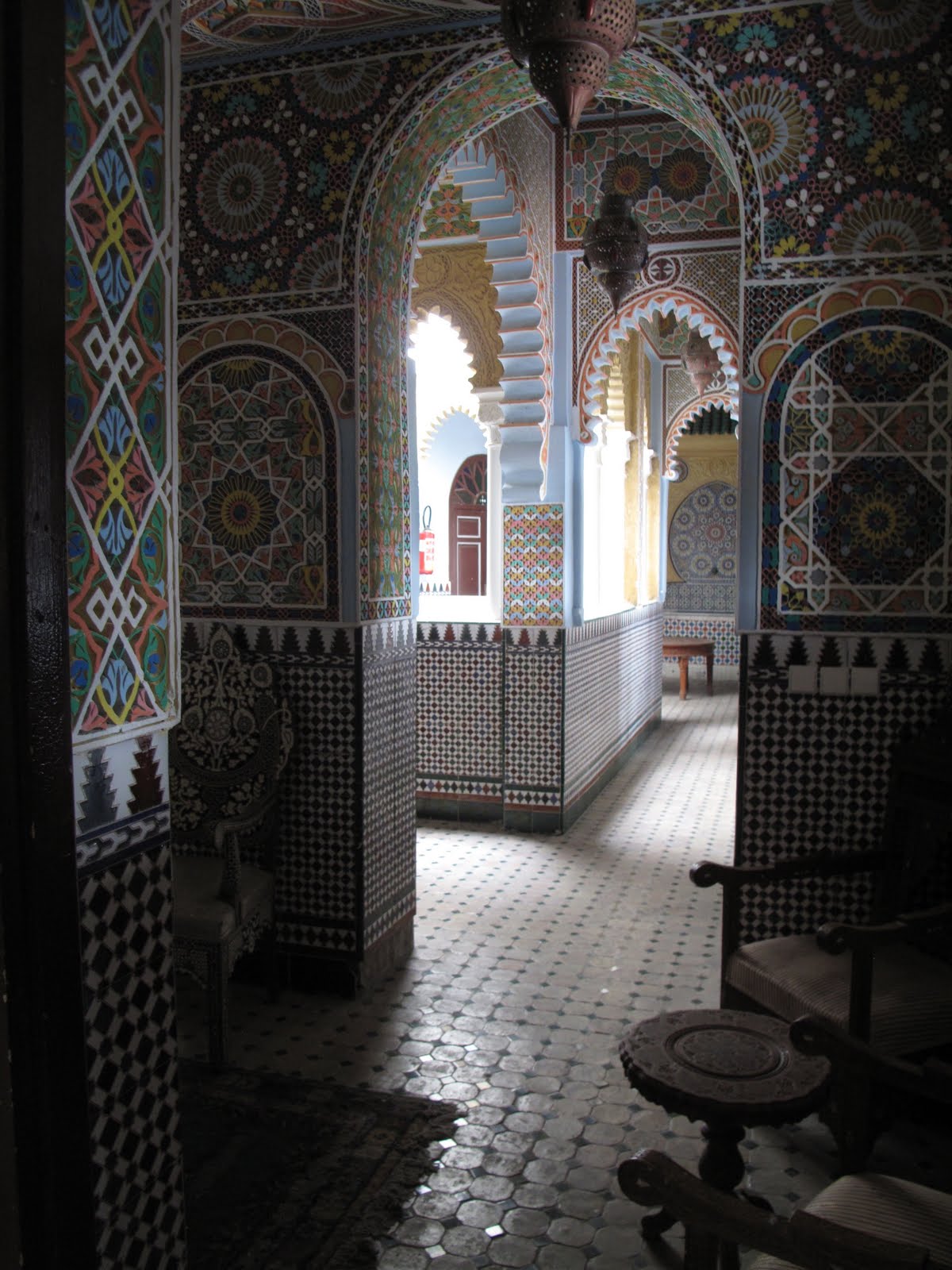
    I hadn't expected to go to Tangiers this year, but somebody came to join me in Tarifa, after my sister's wedding in Bolonia, and as soon as they arrived, we were both set on Tangiers. It was only 45 minutes across the sea, of course. So we went there. To the Hotel Continental, which the British built in 1876, I think. Drifting over the sea, I began to feel anxious. I did not know where I was going. I did not know why I was going, other than that I had never set foot on African soil in my life. I had an image in my mind of Marrakesh, of boiling markets and touters pulling out of you- something like India, in North Africa. I have a Polish friend who fell in love with Morocco, whose husband was offered a few camels for her, because she is so beautiful. She figured she must have been a Bedouin nomad in her past life.


     I had always loved mint tea, and always savoured the mint tea I had had in the tea rooms in Granada, as a teenager.


    And I loved chicken tezhin. There was plenty of both, in Tangiers. And argan oil, and rose oil, and lima oil, which I found in the Madini perfumier, in little hexagonal glass bottles with golden tin tops, just like you see in India. In fact the whole place, with its winding little back streets and its soukhs and its carpet shops and its drapiers and tailors and perfumiers and tea shops and schools of music and butchers with skinned cow's heads and the slippers with upturned Alladin toes and the sleepy hotel, all reminded me of India. Apart from the raw cow heads in the butchers of course. And that there was no filth, no stench. Strange, I almost missed that, I was so used to an anachronistic place stinking to high heaven. And there was less noise. Less jostle, altogether. I mean in Benares, there are men carrying corpses chanting 'Ram! Ram!' as if it meant 'Beep-beep!' pushing past you in the narrow little streets. And there are proud cows that stop for nobody. Not even the irritating mopeds. But that's Benares. A place I can never forget. This was Tangiers, which had a languid kind of post-colonial feel to it. And a melancholy feeling in the air, that this mandolin player seemed to encapsulate, in the School of Music. There was a sweetness and kindness in the people there (apart from the pushy guides), who took my son in their arms, and lifted him up to the sky, as if he was their own. Two days in Tangiers, and all of these memories. I don't know what else to say, except to give you this poem, which says it all, for me:

    In Tangiers


    One morning
    In an alcove
    Of the Hotel Continental
    In Tangiers
    I wrote a secret-
    And shared it with the visiting ghosts,
    While the wedding guests from Paris
    Ate stale croissants
    On the balcony
    And the early breeze
    Ruffled their hair.

    Night came.
    Prayers wailed from the Mosque.
    A mosquito droned past my ear
    Sweat poured from our skin
    In the middle of the Moroccan night.

    And then I knew, that in Tangiers,
    There are no secrets.

    Thursday, 9 June 2011

    Síofra: Portals at Sea

    Síofra: Portals at Sea: "Minke whale as we saw on the sea stretch between Dunquin and the Blasket this past April. I was at an enchanting evening of Kirtan s..."

    Monday, 6 June 2011

    Portals at Sea

    Minke whale as we saw on the sea stretch between Dunquin and the Blasket this past April.


    I was at an enchanting evening of Kirtan singing with  Jack Harrison about a year and a half ago, and between the passions of his singing, he told us the most fascinating stories about music- in this land. 
    His CD, the Wind Across the Sea, says a lot about this, in its title alone. It comes from the understanding in Ireland that music comes through the air, from the Sidhe, or the faeries.  


    The Wind Across the Sea is inspired by the Song of Aimhirghin, the warrior poet said to be the first human to set foot on Ireland, then inhabited by the Tuatha De Dannaan, or the People of Danu. 

    (The Tuatha De Danaan are known throughout ancient Ireland as the people of the goddess Dana/Danu.   Banished from Heaven because they had learned the knowledge of magic,  they came to live in Ireland, which they dominated until they were defeated by the Sons of Mil and were referred to as the 'Sidhe' thereafter).  


    When Amhairghin Glungheal (Amairgin of the White Knees), a bard-shaman of the Sons of Mil, or the Milesians, landed on the Southwest coast of Ireland 2500 years ago, (as is recorded in the 12th Century Book of Invasions), he sang this song to call Ireland out from the mist that the Tuatha had cast over the coast. He composed this song when he had landed: 

    I am the wind across the sea
    I am a dewdrop let fall by the sun.
    I am the fire on every hill. 
    I am the shield over every head. 
    Who (but I) is both the tree and the lightening that strikes it? 
    Who (but I) is the dark secret of the dolmen not yet hewn?
    Who knows the period of the moon?
    Who knows the path of the sun?  


     The mist was lifted, and the first human arrived on Irish soil. No wonder we are wall to wall with poets on this island, having had to seek the permission of an ancient tribe of Sidhe to even inhabit this soil.  

    Jack told another tale,  of the song Port na bPucai, the air of which was first heard by men in a curragh on the waters  between the Blasket and Dunquin, near Dingle. It means 'Song of the Ghosts', or some say, the 'Song of the Faeries'. The latter would suggest we are back to our old friends the Tuatha De Dannan for provenance.  Some say the men were coming back to the island in the mist, and heard this song which they thought was the sound of spirits, or Sidhe, which they had disturbed. So they made this air using the notes they had heard to placate the unhappy spirits. 

    More recently, people say they were hearing whale-song reverberating through the canvas hulls of their boats. But this song, which was brought to this island by the last fiddle player to leave that Blasket island in the 1960's, comes from the old Irish way of seeing the world: that every rock, river, mountain and in this case whale, is inhabited by a spirit. Just as it is in the first poem written here,  the Song of Aimhirghin. The Spirit is in everything- the sun, the moon, the wind and the tree and the lightening. 


    Michael Morris, composer of Eriu's child, has a beautiful version of the Song of Amhairgin. He sees this verse as one of the most magnificent verses in the Irish tradition, a "hymn to the mystery of existence" from Ireland's Dreamtime, embodying the wisdom of Plotinus that "all is each and each is all".  


    There are so many airs that are said to have come from the faeries in Ireland. Danny Boy, for instance.  The original air, the Derry Air is an ancient one taken down 150 years ago from a blind street fiddler in Derry. But Michael Morris says that before that, the song literally rose out of the hedges, when a man who fell off his bicycle, drunk, into a ditch,  and he heard the air.  Luckily, he  remembered it when he sobered up! A song played by Elvis, and sung at Diana's funeral and so many weddings, despite being a song of separation and longing, came from the ditch!   


    Another example of this mysterious exchange is The Coolin,  An Chuilfhionn,  an ancient air said to go back to the 13th Century,  the original words of which describe 'a fairy woman'. Hearing this on Eriu's Child, it's not at all hard to believe that the provenance of this song is from the other side.  


    http://www.rosehall.net/Music/MichaelMorris

    The words to Port na bPucai are as haunting as its air. It is a song that truly emerges from the Passage between the worlds. Listen to it, and be haunted. There are many versions, and a few different titles: Caoineadh Na HInise, The Lament Of The Island, The Music Of The Fairies, Poirt Na BPúcaí, Poirt Na BPucai, Port Na Bpúcaí, Port Na Bpúcai, Port Na BPucaí, Port Na BPucai, Port Na BPuchai, Song Of The Pookas.

     I love this one, by  Cormac Breathnach: 


      Is bean ón slua sí mé, do tháinig thar toinn
    I am a woman from the fairy host who traveled over the seas
    Is do goideadh san oíche me tamall thar lear
    I was stolen in the night and taken beyond the sea
    Is go bhfuilim as ríocht seo fé gheas' mná sídhe
    And I am held hostage in the kingdom by the fairy women
    Is ní bheidh ar an saol seo ach go nglaofaidh an coileach
    And I can only be in this world until the moment the cock crows
    Is caitheadsa féin tabhairt fá'n deis isteach
    I know I have tasks to do here
    Ni thaithneamh liom é ach caithfead tabhairt fé
    Which I do not like but must comply with
    Is caitheadsa féin tabhairt fén lios isteach
    I must return to the fort and do not have anything to do
    Is ná déinig aon ní leis an dream thíos sa leas
    With this body of fairy people down in the fairy mound


    Hearing these stories of music and poetry coming out of the mist, at Jack Harrison's concert made me experience an echo.  Just weeks before I went to his concert, I had written the opening passage to my new book, in which my characters were approaching an island enshrouded in mist, through which came a strange music that had to be deciphered, in order for them to enter the island which was inhabited by a tribe of ghosts that had been massacred during the reign of Elizabeth I. Then I heard these two stories, and again I understood that we are never not being prompted by the muse, that they bring us, as always, exactly where we need to go to find treasure. 


    It doesn't stop there, either. Just last April, I was in Dingle to visit an old friend, who had moved there three years ago. This was the first time I had been there since I was a child, and the only thing I could remember was eating periwinkles with a cocktail stick from a polystyrene tub, somewhere on the street. On our second day, this time, in Dingle, my friend took us out on her boat. It was my son's first time on a boat. I had no idea where we were going. I have to admit, I had even forgotten that we were so close to the Blaskets


     We had a small wish: to see Funghi the Dolphin, but that was about it, and there was no guarantee of even that. Little did we know what we were in for. We bumped straight into Funghi soon after we took off, and sped around (it was a Rib we were on) the coast, past the huge raw chunks of bare cliffs, until we stopped, surrounded by black fins. Sharks, we thought. My son was terrified. I wasn't sure what I should be, being a bit of an obtuse sailor. In the end, it was decided they were minke whales. On we went, heading fast towards the Blaskets. We were then visited by a pod of dolphins, who leaped in and out of the water around us, as if to greet us. An ecstacy of water, movement and blissful play.  My son shrieked with delight, as I think I did too. Funghi was one thing but this was epic...

    It wasn't long before the Minke whales were back, skulking around us, just after the dolphins had gone away. Then we looked at the bank on the Blasket: we were being watched by a hundred seals. No I didn't count, but there were at least that many.  My son wasn't scared anymore. He had been met by all the guardians of this sea. He knew he was safe. 


    And it was only when I got back, that I understood where I had been.  The air of Port na bPucai had come from this very place.‎.. according to one source, the men in the curraghs heard the air when they were in this stretch of water between Dún Chaoin and the Blasket Islands, called the Blasket Sound. Just where we had met the dolphins and the minke whales. 


     Whether it was whale song, or the keening of a wandering faery woman, this was the very place. And I had come here, not even knowing where I was. It makes me wonder, again and again, who is in charge? 

    "The tune is expressive of the spirit of the island and also of the
    belief, central to fairy lore, that fairies imitate mortal beings and
    their lives. A great deal of lore exists about fairy music and there
    are numerous accounts of fairies playing music and dancing."
    
    
    (R. Flower, The Western Island or The Great Blasket, Oxford 1946).


    Maybe it's a good thing, that I don't go around with guidebooks when I visit a place. Things just happen.  I know, my geography is appalling. I don't have a Sat Nav, I go blank when I look at a map, and similarly when I am given directions. It's as if I just go 'Puff!' inside my brain. But I don't care, because I find myself following a secret thread, nudged along, all the time, by my muse, and led to exactly where I need to be.